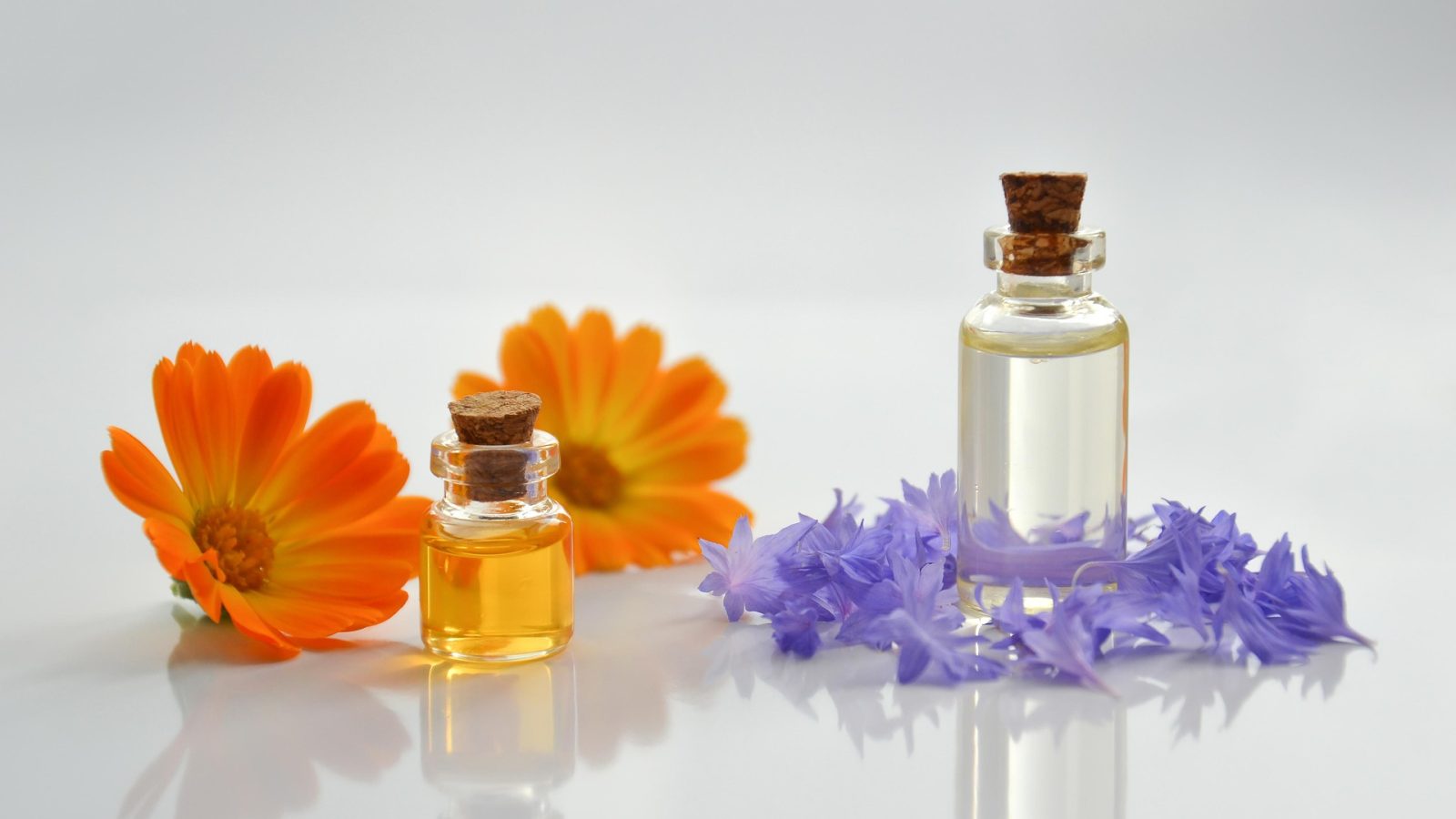
Calendula oil sounds like a simple ingredient. It isn’t. A bottle described as calendula oil might contain a carrier oil infused with flowers, a concentrated extract or, much more rarely, the volatile essential oil of Calendula officinalis. They all begin with the same golden flower, but chemically they are very different ingredients.
Walk into a natural skincare shop and the words calendula oil appear reassuringly straightforward, suggesting a single ingredient obtained from the familiar orange flowers of Calendula officinalis. But botanical ingredients are rarely that simple. A bottle described as calendula oil may contain dried calendula flowers macerated in sunflower oil, another might contain calendula extracted into olive oil, a cosmetic cream may contain an aqueous, glycerine or hydroalcoholic extract, and a specialist supplier might offer a concentrated CO2 extract. Rather surprisingly, calendula can also produce a genuine essential oil. These materials are not interchangeable. They are created by different processes, they extract different molecules, they possess different physical properties, and evidence obtained using one preparation cannot automatically be transferred to another, a distinction examined in full under Ingredient Forms and Chemistry in our Calendula monograph. Understanding this reveals something bigger than the story of calendula. It demonstrates one of the fundamental principles of botanical cosmetic science: the plant is only the beginning of the ingredient.
What exactly is calendula oil?
There is no single substance that can scientifically be described simply as calendula oil. The term is used commercially for several different materials, but most commonly it refers to an oil macerate. Dried calendula flowers are placed in a vegetable oil, perhaps sunflower, olive or another suitable carrier, and allowed to remain there while oil-soluble constituents migrate from the plant material into the surrounding lipid, after which the flowers are filtered away. What remains is not oil produced by calendula. It is the original carrier oil containing compounds extracted from calendula, a distinction easy to miss: if calendula flowers are macerated in sunflower oil, most of the liquid in the resulting bottle is still sunflower oil, and if extracted into olive oil, most of it is olive oil. The carrier contributes its own fatty acids, antioxidants, texture, oxidative stability and sensory properties, and the calendula contributes another chemical fraction; together they form the finished ingredient. But there is another substance that complicates the terminology considerably. Calendula has a genuine essential oil.
Calendula essential oil really does exist
Calendula is not normally thought of as an essential-oil plant. Mention lavender, peppermint, rosemary or eucalyptus and steam distillation immediately seems natural; mention calendula and most people imagine an orange-coloured infused oil, and there is a good reason. Calendula officinalis produces relatively little volatile oil. In a frequently cited 1991 investigation, researchers Chalchat, Garry and Michet obtained essential oil from calendula flowers and whole plants using steam distillation with cohobation, and the yield was approximately 0.3 per cent, nothing like the abundant aromatic crops cultivated specifically for efficient essential-oil production. Nevertheless, an essential oil was obtained, and using gas chromatography and mass spectrometry the researchers identified 66 constituents. Its composition was interesting: rather than being dominated by the light monoterpenes many people associate with familiar aromatic oils, the calendula essential oil was particularly rich in sesquiterpene alcohols, with the principal constituent, alpha-cadinol, accounting for approximately one quarter of the oil. The researchers also found differences between oil distilled from the flowers and oil obtained from the whole plant, since whole-plant material contained additional monoterpene hydrocarbons, illustrating how even the part of the plant entering the still can change the resulting ingredient. So calendula essential oil is real. But that does not make it equivalent to calendula-infused oil.
Why calendula essential oil is unusual
Essential oils are sometimes described as the essence of a plant, but chemically that description is misleading. Steam distillation does not somehow collect everything useful within a botanical. It selectively captures compounds capable of volatilising under the conditions of distillation and subsequently separating into the essential-oil phase, and many other plant constituents remain behind. This matters enormously for calendula. The flowers contain several important groups of phytochemicals, including triterpenoids, triterpene alcohols and esters, flavonoids, carotenoids, phenolic compounds, polysaccharides, sterols and volatile compounds, and these molecules do not all possess the same solubility or volatility. Some dissolve preferentially in oils, some are better extracted by alcohol-water mixtures, some are water soluble, some can be recovered using supercritical carbon dioxide, and only a particular volatile fraction becomes the steam-distilled essential oil. Essential oil therefore does not mean concentrated whole calendula. It means one particular chemical fraction of calendula, and that distinction is fundamental to interpreting the evidence we set out in Can Calendula Really Heal Skin?.
Calendula-infused oil
The ingredient most consumers encounter as calendula oil is very different. An infused or macerated oil is produced by allowing calendula plant material, usually dried flowers, to remain in a fixed vegetable oil for a defined period, in a carrier that might be sunflower oil, olive oil, jojoba, sweet almond oil or another cosmetically suitable lipid. During maceration, compounds capable of dissolving into the lipid phase migrate from the plant material into the carrier, and the mixture is eventually filtered; the process can be performed at room temperature over an extended period or accelerated under carefully controlled warmth. Unlike steam distillation, maceration does not create a separate volatile essential oil, and the carrier remains part of the final ingredient. This has an important consequence: two products both described as calendula-infused oil may differ considerably, since one might contain calendula extracted into high-oleic sunflower oil, another might use olive oil, and another might use jojoba, giving them different fatty-acid profiles, oxidative stability, texture, absorption characteristics and shelf lives even before differences in calendula extraction are considered. The words calendula oil tell us surprisingly little.
What does an oil infusion actually extract?
This is where botanical chemistry becomes particularly interesting. Extraction depends substantially upon solubility. Plant tissue contains an extraordinarily complex mixture of molecules, and when that material is placed into a solvent, the solvent does not indiscriminately remove everything; instead, compounds migrate according to their chemical characteristics and affinity for the extraction medium. An oil preferentially extracts lipophilic, or fat-soluble, constituents, and calendula’s triterpenoid fraction is particularly relevant here, alongside carotenoids and other relatively lipophilic compounds. The familiar golden-orange colour of many calendula macerates partly reflects pigments extracted from the flowers, but colour should not be treated as a direct measurement of potency, since different cultivars contain different pigment concentrations, extraction conditions vary, carrier oils possess their own colours, plant-to-oil ratios differ, and commercial processing can influence the final appearance. A dark orange oil is therefore not automatically a more effective calendula ingredient than a pale yellow one. Colour tells us something. It does not tell us everything.
Calendula extracts
Change the solvent and the chemistry changes. Calendula can be extracted using mixtures containing water and ethanol, among other systems, and the European Medicines Agency’s herbal monograph provides an unusually useful illustration. Among the recognised traditional calendula flower preparations are liquid extracts produced using 40 to 50 per cent ethanol, tinctures produced at a drug-to-extract ratio of 1:5 using 70 to 90 per cent ethanol, and extracts produced using fatty vegetable oils such as olive oil. These are all calendula preparations, but they are chemically different preparations. Alcohol-water systems can recover compounds that an oil alone extracts poorly, and changing the ratio of alcohol to water changes solvent polarity and therefore changes which compounds are preferentially extracted. The plant-to-solvent ratio matters too, as do extraction temperature, extraction duration, particle size, moisture content, flower quality, cultivar, harvest conditions, storage and subsequent processing. This is why reading a scientific paper stating that calendula extract produced a particular biological effect is not enough. We need another question: which calendula extract?
Water extracts another chemical fraction again. Calendula flowers can be infused in water, much as herbal teas have been prepared for generations, and water preferentially recovers more polar constituents, making aqueous preparations fundamentally different from an oil macerate or essential oil. It also creates another problem: microbiology. Once water becomes part of a cosmetic formulation, microorganisms can potentially grow within it, and a homemade botanical infusion should never be assumed to possess a useful shelf life simply because calendula itself has demonstrated antimicrobial activity in laboratory experiments. Commercial water-containing cosmetics require appropriate preservation, hygienic manufacturing, stability assessment and microbiological control, and the presence of a botanical does not replace those requirements, a caution we set out in practical terms in our own Sunday Reset ritual. This distinction becomes particularly important when traditional household recipes migrate onto social media and are presented as modern skincare formulations; a preparation that was made fresh and used immediately by an earlier generation is not necessarily safe when bottled and stored for weeks.
Cosmetic formulators can also use glycerine-containing extraction systems. Glycerol is familiar to skincare users primarily as a humectant, but it can also form part of botanical extraction systems, and commercial extracts frequently employ combinations of water, glycerine and other solvents to obtain desired phytochemical fractions while creating an ingredient compatible with the intended formulation. Again, the finished material is not equivalent to an oil infusion, nor is it equivalent to an essential oil, which is one reason INCI information and supplier technical documentation matter. The botanical name tells us where an ingredient began. The extraction information tells us much more about what eventually reached the formulation.
CO2 extraction
Another category sometimes encountered in specialist botanical formulation is carbon-dioxide extraction. Under sufficiently high pressure and controlled temperature, carbon dioxide can enter a supercritical state possessing properties of both gases and liquids, and in this state it becomes an effective extraction medium; when pressure is subsequently reduced, the carbon dioxide dissipates, leaving the extracted material behind. Supercritical CO2 extraction can recover lipophilic botanical compounds without the prolonged high temperatures associated with some conventional processes and without leaving a conventional organic extraction solvent in the finished extract, but once again, CO2 calendula extract is not calendula essential oil, nor is it simply a stronger calendula macerate. It represents another selectively extracted chemical fraction. This recurring distinction may seem pedantic. It is actually central to understanding botanical ingredients.
Consider four bottles sitting beside one another. The first, calendula essential oil, is produced through steam distillation, has an extremely low yield, and contains predominantly volatile compounds; the classic analysis found a sesquiterpene-rich composition with alpha-cadinol as its principal constituent. The second, calendula-infused sunflower oil, is produced by extracting calendula flowers into sunflower oil and contains the sunflower oil itself plus calendula-derived lipophilic constituents, its fatty-acid composition coming predominantly from sunflower. The third, a calendula hydroalcoholic extract, is produced using an ethanol-water solvent system, recovering a different spectrum of constituents according to solvent concentration and processing conditions, and suited to different types of formulations. The fourth, a calendula CO2 extract, is produced using pressurised carbon dioxide and provides another concentrated fraction of predominantly lipophilic constituents. All four can legitimately originate from Calendula officinalis. Chemically, they are not the same ingredient.
Why extraction method matters to the evidence
This becomes particularly important when we start asking whether calendula works, a question we examine at length in Can Calendula Really Heal Skin? and in How Skin Heals. Calendula has a centuries-old reputation for irritated and damaged skin, described in our Botanical Archives entry, and modern laboratory and clinical research has consequently investigated its potential effects upon inflammation and wound repair. But there is a trap. Imagine a study finds that a particular hydroalcoholic calendula extract influences inflammatory signalling in cultured cells. It would be scientifically inappropriate to conclude that calendula essential oil therefore does the same thing. Likewise, if a clinical investigation uses a defined calendula ointment, its results cannot automatically be applied to every calendula-infused facial oil sold commercially. The formulation matters, the extraction matters, the concentration matters, the dose matters, the biological model matters, and the endpoint matters.
The European Medicines Agency provides an excellent example of this caution. Its conclusions regarding calendula flower preparations for minor skin inflammation and as an aid in healing minor wounds are based upon traditional use, not a sufficiently robust clinical evidence base to establish well-established medicinal use, and the EMA considered clinical studies involving conditions including burns, venous leg ulcers and skin inflammation but concluded that methodological problems prevented firm conclusions. There is enough history and biological plausibility to make calendula scientifically interesting. There is not enough evidence to turn every calendula preparation into a proven wound-healing treatment.
Does calendula essential oil heal skin?
We do not currently have a strong basis for making that claim, which is perhaps the most important point in this article. Because calendula essential oil exists, it is tempting to combine two true statements, that calendula has traditionally been associated with wound healing and that calendula produces an essential oil, and arrive at an unsupported third statement, that calendula essential oil heals wounds. That conclusion does not automatically follow. Much of the research and traditional-use documentation surrounding calendula involves flower preparations, tinctures, extracts, infusions, ointments or oil-based preparations rather than isolated steam-distilled essential oil, so the evidence must be evaluated preparation by preparation. Calendula essential oil has interesting chemistry. That alone does not establish clinical efficacy.
Which calendula ingredient belongs in skincare?
There is no universal answer. It depends upon what the formulator is trying to achieve. An anhydrous balm might accommodate an oil macerate particularly well, an emulsion could incorporate a standardised botanical extract, a lightweight water-based product may use a supplier-designed water and glycerine extract, and a specialist formulation might employ a concentrated CO2 extract, with little reason at all to use the rare essential oil. The question should therefore not be which is the strongest calendula. It should be which calendula preparation provides the chemistry and formulation characteristics appropriate for this product. That is a much more useful question.
How to read a calendula ingredient label
When calendula appears prominently on packaging, turn the bottle around and look at the ingredient list. You may encounter terminology corresponding to calendula flower extract, flower oil or other calendula-derived ingredients, often alongside the carrier or extraction medium. Then look at the formulation as a whole. Is calendula one component of a well-designed moisturiser containing glycerine, emollients and barrier-supportive ingredients, or is it primarily an oil-based product? Does the brand explain which calendula preparation it uses, and does it provide meaningful information about extraction, or does the marketing simply say with healing calendula? Transparency becomes particularly useful with botanicals because the plant name alone reveals so little about the chemistry actually present.
There is a tendency to imagine botanical extraction as something separate from chemistry. It isn’t. Place flowers in oil and chemistry determines what dissolves; place them in alcohol and chemistry determines what dissolves; pass steam through them and physical chemistry determines which volatile molecules travel with it; expose them to supercritical carbon dioxide and intermolecular interactions again determine what is extracted. The traditional herbalist might not have used terms such as solvent polarity, partition coefficient or volatility, but the preparations they created were governed by those principles nonetheless. A jar of flowers sitting in oil on a sunny windowsill may look wonderfully removed from the laboratory. Molecularly, extraction is occurring all the same.
There is another reason the phrase calendula oil can be misleading. In a macerated oil, the carrier is not an inert container: sunflower oil contributes its own fatty-acid profile, olive oil contributes another, and jojoba is chemically unusual because it consists predominantly of liquid wax esters rather than conventional triglycerides. Each behaves differently on the skin and during storage, each oxidises differently, and each changes the sensory character of the finished calendula ingredient, meaning comparing two calendula macerates without considering their carrier oils is rather like comparing two cups of tea while ignoring the water. The extraction medium is part of the ingredient.
Botanical marketing frequently encourages a simple hierarchy, extract to concentrated extract to essential oil, as though each step represents greater potency, but chemistry does not work that way. An essential oil can be extraordinarily concentrated in volatile compounds while containing virtually none of another class of constituents responsible for an activity observed in a different extract, a CO2 extract may concentrate desirable lipophilic molecules but be inappropriate for a formulation designed around water-soluble constituents, and an aqueous extract can contain compounds absent from the essential oil. There is therefore no meaningful universal scale from weak to strong. There are simply different chemical fractions designed or selected for different purposes.
The bigger lesson
Calendula provides a particularly beautiful demonstration of why botanical skincare deserves more careful language. At first glance there is one plant, Calendula officinalis, golden flowers, a long history of use, a familiar association with skin comfort and healing. Look more closely and that single plant becomes many ingredients. Steam captures one fraction, oil another, water another, alcohol changes the picture again, and supercritical carbon dioxide offers another possibility, while drying, cultivation, plant part, extraction temperature and processing introduce still more variation. By the time calendula reaches a finished cosmetic product, asking whether the formulation contains calendula is therefore only the first of several much more useful questions, the ones this Library keeps returning to: which part of the plant, extracted how, into what, at what concentration, and to what end. That is where the interesting answers live.
Continue exploring
Botanical Library · Monograph No. 005
Calendula, Calendula officinalis
The complete ingredient monograph, including Ingredient Forms, Chemistry and the evidence for skin in full.
Journal · Skincare
Can Calendula Really Heal Skin?
What the clinical evidence actually says about calendula and wound repair.
Journal · Botanical Science
How Skin Heals
The biology of wound repair, and why laboratory evidence is not clinical evidence.
References
- Chalchat, J.C., Garry, R.P. & Michet, A. (1991). Chemical composition of essential oil of Calendula officinalis L. (pot marigold). Flavour and Fragrance Journal, 6(3), 189-192. doi:10.1002/ffj.2730060306
- European Medicines Agency, Committee on Herbal Medicinal Products (HMPC). European Union herbal monograph on Calendula officinalis L., flos, revision 1. EMA/HMPC/437450/2017, adopted 27 March 2018. EMA/HMPC monograph
- European Medicines Agency. Assessment report on Calendula officinalis L., flos, revision 1. EMA assessment report