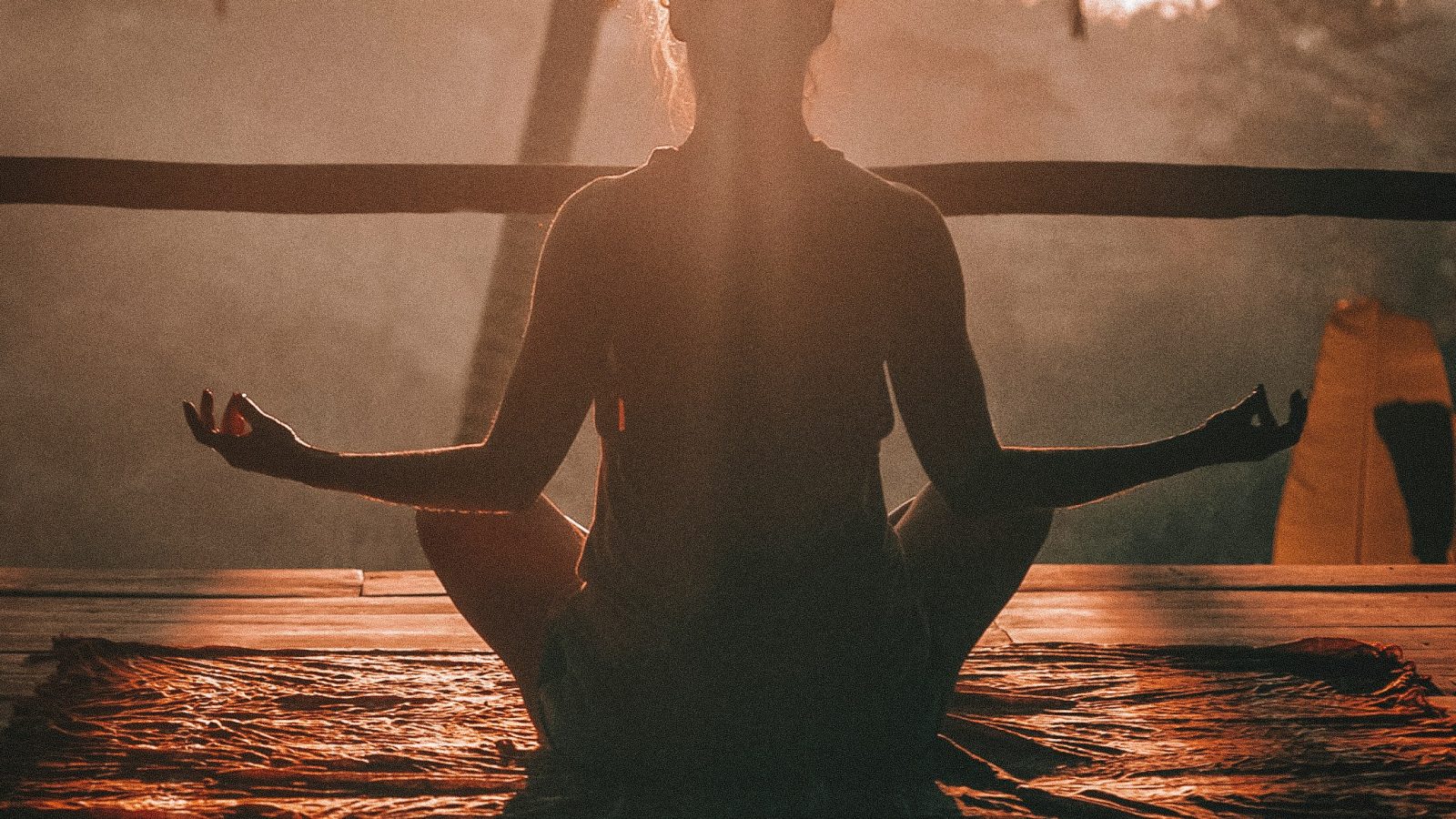
Every Sunday evening, before the week has a chance to properly start dreading itself, I lay out a bolster, two blankets and a wall, and spend forty minutes doing almost nothing. This is the full history of restorative yoga, what the evidence specifically says about practising it in the evening rather than any other time, and why I think Sunday, of all days, is when it earns its keep.
We have already set out the general case for restorative yoga in detail in a separate, thoroughly referenced article, covering its development under B.K.S. Iyengar, the metabolic-syndrome trials, and the important cortisol findings that complicate the popular “resets your nervous system” story. I do not want to repeat all of that here. What I want to look at properly is something more specific: what happens when this particular practice is done specifically in the evening, and specifically on a Sunday, rather than at any other point in the week.
A short history, for context
Restorative yoga in its modern, heavily supported form developed through B.K.S. Iyengar’s use of props, blocks, belts, blankets and chairs, originally intended to adapt postures to individual bodies rather than to build an entirely rest-focused practice. Judith Hanson Lasater, one of Iyengar’s students, is widely credited with developing and popularising the specific, deliberately restful style now commonly taught as restorative yoga. It is, in other words, a genuinely modern practice, considerably younger than its calm, timeless reputation suggests, built from much older postural traditions but assembled into its current form within living memory.
Why Sunday evening, specifically
There is a reasonably well-documented phenomenon, sometimes called anticipatory work-week anxiety, in which the transition from the weekend to the working week produces a measurable rise in stress and low mood, often beginning on Sunday afternoon or evening rather than on Monday morning itself. The proposed mechanisms are straightforward: uncertainty about the week ahead, the loss of unstructured time, and simply having space, for the first time in days, to notice worries that busier weekend activity had crowded out. A consistent Sunday evening routine is frequently suggested as a way to give the transition structure and a sense of control, rather than leaving it to arrive unstructured and be experienced as dread.
Restorative yoga is a genuinely good fit for that specific moment, better suited to it, I would argue, than either a vigorous workout, which can feel like starting the week’s demands early, or simply scrolling a phone, which tends to add anticipatory noise rather than settle it. A supported, quiet practice gives the transition somewhere deliberate to go.
What the evidence says about evening and pre-sleep practice specifically
This is the part that genuinely extends beyond our general restorative yoga article, because the most relevant research here concerns yoga practised in the evening, close to sleep, rather than yoga practised at any time of day. A randomised controlled trial examining a gentle yoga programme in older women with restless legs syndrome, a condition that specifically disrupts evening rest and sleep onset, found that the yoga group showed significantly greater improvement than controls in sleep quality, mood, anxiety and blood pressure. This is a specific population with a specific evening-disruption condition, not a general population study, but it is directly relevant to the question of whether a gentle, supported practice performed in the evening measurably improves the transition into rest, and the answer in that trial was yes.
Separately, a randomised controlled trial examining Yoga Nidra, a deeply restful, largely reclined guided practice closely related in spirit to restorative yoga, measured both psychological outcomes and diurnal salivary cortisol, comparing groups practising for different durations against an active music-listening control and a waitlist control. This kind of design, measuring an actual physiological stress marker across the day rather than relying purely on self-reported mood, is exactly the kind of evidence our general restorative yoga piece noted was often missing from more general yoga-and-stress research, and it strengthens the specific case for a reclined, deeply supported evening practice rather than a generic “yoga helps stress” claim.
A broader body of research on yoga and sleep quality, including work in populations with chronic pain and chronic insomnia, has consistently found improvements in sleep quality, anxiety and mood following structured yoga practice, with tailored, individualised approaches showing particularly encouraging results in people with diagnosed sleep difficulty. None of this is restorative-yoga-specific in every case, and I want to be honest about that rather than overstate it, but taken together it builds a considerably more specific, evening-relevant case than the general daytime stress research covered in our other piece.
What I actually do, step by step
The practice itself is simple, and deliberately so. I use one bolster, two firm blankets, and a wall, nothing more elaborate than that. I begin with a supported reclined position, legs up the wall, bolster under the lower back, and stay there for around ten minutes, doing nothing but breathing and letting my legs be genuinely heavy rather than held. From there I move into a supported child’s pose, torso fully resting on the bolster rather than hovering above it, for another ten minutes. I finish with a supported reclined bound angle position, knees dropped open and supported by rolled blankets, for a final ten to fifteen minutes, usually with the room lit by a single lamp rather than overhead light. The whole sequence takes under forty minutes, and the point, deliberately, is that almost nothing happens during it that could be described as effort.
What I notice, honestly
I do not want to claim this resets my nervous system or lowers my cortisol on a Sunday specifically, because, as our other piece sets out in detail, the research on that exact claim is genuinely mixed, and I try to hold myself to the same standard here that I would apply to anyone else’s claims. What I notice, consistently, is that Monday feels less like an ambush. Whatever anticipatory anxiety the week ahead would otherwise arrive with has somewhere to go on Sunday evening, rather than arriving unprocessed on Monday morning, and forty minutes of doing deliberately little seems to be enough to make that difference, at least for me.
Restorative, not yin, and why that distinction matters here specifically
It is worth being precise about which practice this actually is, since restorative yoga and yin yoga are frequently confused, and the difference matters for a Sunday evening wind-down specifically. Yin yoga deliberately produces a real, sustained sensation of stretch in connective tissue, which can be genuinely valuable but is not, in my experience, the right sensation to end a week on if the goal is settling rather than working through something. Restorative yoga, properly supported so that no meaningful stretch sensation occurs at all, is the better fit for an evening whose entire purpose is arriving at stillness rather than doing anything to the body.
Building your own version
None of this requires the specific sequence I use. Firm pillows substitute reasonably well for a bolster, folded towels work in place of proper yoga blankets, and a wall is, usefully, already in every home. The details matter less than two decisions: choosing a consistent time, ideally Sunday afternoon or early evening rather than right before bed, when anticipatory anxiety about the week has research support for being at its most acute, and committing to genuinely minimal effort throughout, resisting the temptation to turn it into a stretching session or a chance to check phone notifications between postures.
What this is not
This is not a treatment for diagnosed anxiety, insomnia or depression, and anyone experiencing those conditions in a persistent, significant way deserves proper clinical support rather than a Sunday evening routine, however well-evidenced the general practice is. It is a genuinely well-supported, low-cost, low-risk way to give a difficult transitional moment in the week some deliberate structure, and for me, that has turned out to be worth considerably more than the forty minutes it takes.
Frequently asked questions
Why do I feel anxious on Sunday evenings?
This is commonly described as anticipatory work-week anxiety, thought to arise from uncertainty about the week ahead and the loss of unstructured weekend time, often surfacing once other weekend activity stops occupying attention. A consistent Sunday evening routine is frequently suggested as a way to give that transition structure rather than leaving it to arrive unprocessed.
Is restorative yoga good before bed?
Research on gentle, restorative-style yoga practised in the evening, including trials in populations with sleep-disrupting conditions such as restless legs syndrome, has found genuine improvements in sleep quality, mood and anxiety. A reclined, deeply supported practice with minimal stretch sensation is generally better suited to winding down than a more active style.
What is the difference between restorative yoga and Yoga Nidra?
Restorative yoga uses physical postures, supported by props, to remove muscular effort from the body. Yoga Nidra is a guided, largely still meditation practice, usually performed lying down, focused on systematic relaxation and body awareness rather than moving through supported postures. Both aim for deep rest, but restorative yoga still involves distinct physical positions, while Yoga Nidra is closer to a guided, conscious form of rest.
How long should a restorative yoga session be?
There is no fixed requirement, but most restorative sessions, including the one described here, run between thirty and sixty minutes, spent across a small number of supported postures held for ten minutes or more each, since the benefit comes from sustained stillness rather than moving quickly between positions.
Do I need special equipment for restorative yoga at home?
No. A bolster and proper yoga blankets are helpful but not essential; firm pillows, folded towels and a wall are perfectly adequate substitutes for a home practice.
Continue exploring
Journal · Living Well
Restorative Yoga: The Practice of Doing Less
The complete general evidence base, including the metabolic-syndrome trials and the cortisol findings that complicate the popular “nervous system reset” claim.
Journal · Living Well
Yin Yoga: What It Actually Is
Why yin yoga’s real sensation of stretch makes it a better fit for a different moment than a Sunday evening wind-down.
References
- Innes, K.E. & Selfe, T.K. (2012). The effects of a gentle yoga program on sleep, mood, and blood pressure in older women with restless legs syndrome (RLS): a preliminary randomized controlled trial. Evidence-Based Complementary and Alternative Medicine, 2012, 294058. PMC3303621
- Moszeik, E.N. et al. (2025). The effects of an online Yoga Nidra meditation on subjective well-being and diurnal salivary cortisol: a randomised controlled trial. Stress and Health. PMC12080877
- Tailored individual yoga practice improves sleep quality, fatigue, anxiety, and depression in chronic insomnia disorder. BMC Psychiatry. PMC9012014