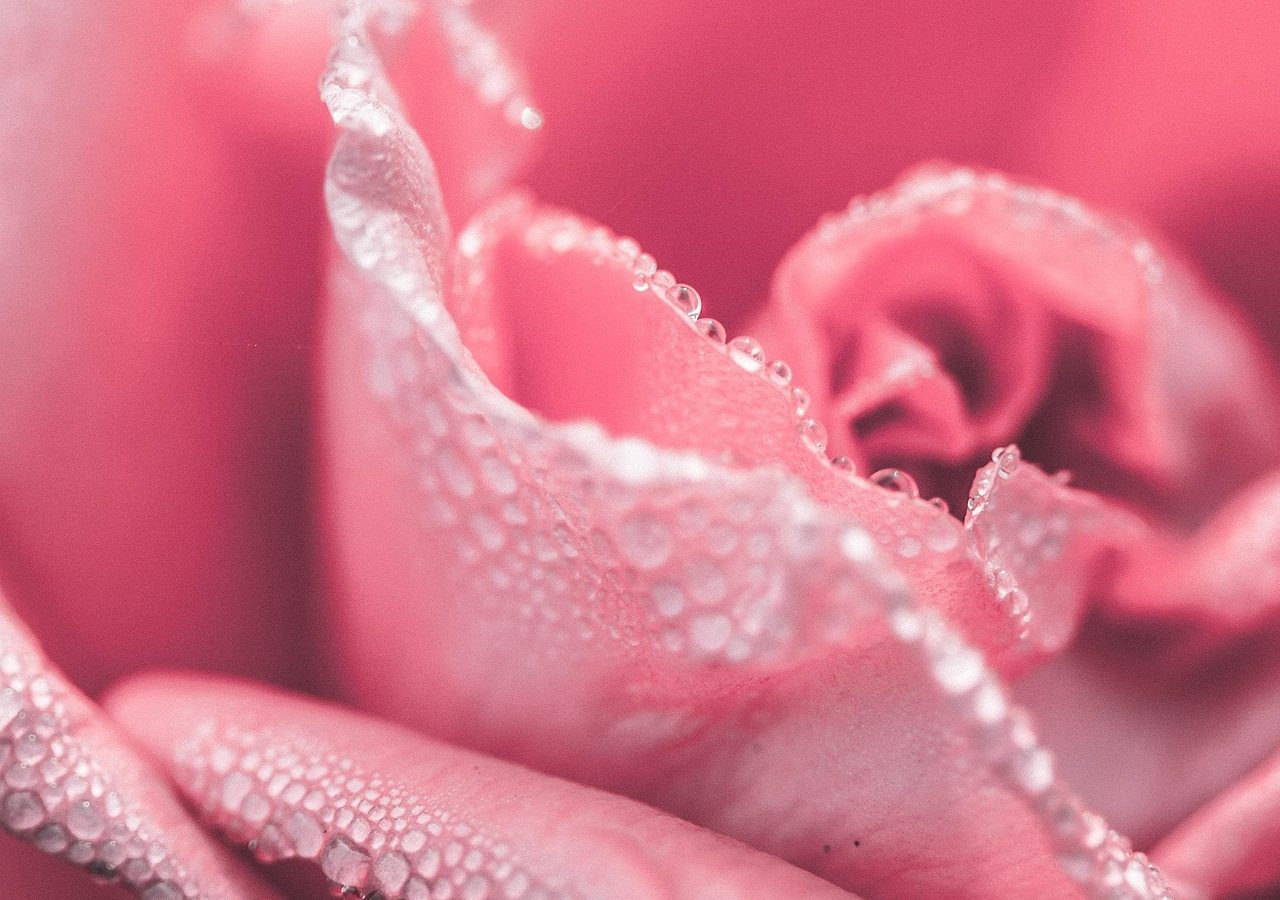
There is a particular pleasure in washing your face at the end of a long day, partly because it is practical and partly because the familiar action can mark a change of pace. Sunscreen, makeup, sebum and the ordinary accumulation of the day are removed, clothes are changed, lights become softer and, gradually, work gives way to evening. Skincare fits naturally into that transition, not because the end of every day requires an elaborate ten-step routine, but because a few familiar actions can become a useful way of slowing down and paying attention to how our skin actually feels.
Rose water makes an interesting companion to such a ritual because its relationship with personal care reaches much further back than the modern cosmetics industry. As we explored in Botanical Archives No. 002, rose has moved between food, fragrance, medicine, ceremony and domestic life for centuries, while the aromatic waters produced through distillation developed traditions of their own. A contemporary bottle of Rosa damascena hydrosol may carry an INCI list, batch number and modern preservation system, but the underlying idea, using distillation to capture some of the volatile character of freshly harvested roses, belongs to a much older technological and cultural history.
What do we actually mean by rose water?
The expression sounds almost self-explanatory, but it can conceal quite a lot of chemistry. During the distillation of aromatic rose flowers, particularly the Damask rose, Rosa × damascena, volatile compounds travel with steam before the vapour is cooled and condensed. The resulting distillate contains an aqueous aromatic phase, the hydrosol or rose water, and, where sufficient quantities are present, a separate essential-oil phase. Chemical analyses of rose waters have identified phenethyl alcohol, geraniol and citronellol among characteristic volatile constituents, although their proportions can vary considerably with cultivar, growing conditions, harvesting and production method.
This distinction matters because a rose hydrosol is not simply rose essential oil with some water added to it, nor is it interchangeable with rose absolute or rosehip oil. Research comparing Rosa damascena essential oil, hydrosol and absolute demonstrates that these materials have substantially different chemical profiles. In cosmetic language they can all become compressed into the appealing word rose, but from a formulation perspective they are quite different ingredients. That might seem unnecessarily technical for an evening ritual, yet it illustrates one of the ideas running through the Botanical Library. A plant is not a single ingredient. Explore Rose, Botanical Library 002 →
An aromatic water with a much longer life
Rose water is particularly interesting because cosmetics did not invent it. It has longstanding uses in food, fragrance, traditional preparations and ceremony, and rose-water production remains culturally important in several rose-growing regions. The history we explored in The Botanical Archives No. 002 is therefore not merely background to a modern cosmetic ingredient; modern skincare has inherited a material that already possessed a substantial cultural life.
That continuity is part of what makes a ritual built around rose water appealing. There is no need to pretend that we are reproducing an ancient beauty ceremony exactly as it would have been performed centuries ago, because we almost certainly are not. Our bottle has been manufactured using modern equipment, packaged hygienically and, ideally, formulated or preserved with contemporary microbiological safety in mind. Nevertheless, the underlying sensory experience, the delicate fragrance of aromatic rose compounds carried in water, connects a very modern bathroom with a much older tradition of distillation.
Beginning at the end of the day
The ritual itself should remain deliberately uncomplicated. Begin by putting aside whatever has occupied your attention during the day and wash your hands before cleansing your face in the way that normally suits your skin. The objective is to remove sunscreen, makeup, excess sebum and accumulated material without pursuing the tight, squeaky sensation that can sometimes be mistaken for particularly effective cleansing.
Our article on the skin barrier explains why that distinction matters. The stratum corneum is not an inconvenient layer of dead material that needs to be scrubbed away before skincare can work; it is a sophisticated permeability barrier whose organised lipids and corneocytes help regulate water loss and protect the living tissues beneath. Cleansing is necessary, but repeated aggressive cleansing can disturb that system, which is why an evening ritual intended to be restorative should begin with respect for the skin rather than an attempt to strip it into submission.
Once cleansing is finished, gently pat away excess water and take a moment before reaching automatically for the next bottle. This is not an invitation to diagnose every patch of skin in the mirror, but simply to notice what is there. Skin that feels comfortable after cleansing may need very little, whereas tightness, dryness or irritation can tell us something useful about how our routine is working. The rose water can then be applied according to the manufacturer’s instructions, perhaps as a fine mist or with clean hands depending upon the product. There is no need to soak the skin, and there is certainly no benefit in trying to create a stronger preparation by adding essential oil to it. A properly produced cosmetic rose water has already been created for its intended purpose; turning it into an improvised essential-oil mixture does not make it more effective and introduces quite different formulation and safety considerations.
Allowing fragrance to remain fragrance
Once applied, the most immediately apparent quality of rose water is likely to be its fragrance, and there is something rather refreshing about allowing that fragrance to exist without requiring it to become medicine. Rose and rose-derived preparations have been investigated for a variety of biological and psychological effects, and the broader literature around Rosa damascena is interesting. The difficulty begins when results obtained using one preparation, dose or experimental setting are transferred wholesale to another. Evidence concerning concentrated rose essential oil, for example, cannot automatically tell us what a lightly aromatic cosmetic hydrosol will do when misted onto the face.
The antimicrobial literature provides a particularly useful example. Laboratory work has found antibacterial activity in some rose preparations, particularly more concentrated materials, but a human study involving 45 volunteers compared Rosa damascena hydrosol with an alcohol-based hand antiseptic and found no significant reduction in bacterial colony counts following use of the hydrosol, whereas the alcohol preparation produced the expected reduction. That does not make rose water a poor cosmetic ingredient; it simply means that describing it casually as an effective antiseptic would go beyond what this human study demonstrated. The fragrance therefore does not need a physiological story attached to it. If the smell of rose makes an evening routine more pleasurable, provides a familiar sensory marker at the end of the day or simply happens to be a fragrance you enjoy, those are perfectly legitimate reasons for choosing it.
Finishing with what the skin actually needs
After the rose water, the practical skincare part of the ritual can remain equally simple. A suitable moisturiser can be applied while the skin still feels comfortable, particularly if cleansing tends to leave it dry. Depending upon the formulation, that moisturiser may combine humectants, emollients and occlusive ingredients that influence hydration and water loss through different mechanisms. It may also contain another ingredient already in our Botanical Library: vitamin E.
Tocopherol and Tocopheryl Acetate appear frequently in cosmetic formulations, although their roles should not be confused with that of rose water. As we explore in Botanical Library Monograph No. 003, vitamin E belongs to a family of lipid-soluble compounds with important antioxidant chemistry, and tocopherols can also have useful functions within formulations containing oxidation-sensitive lipids. Rose water, vitamin E and the moisturiser as a whole therefore occupy different places within the same routine, which is why reading an ingredient list as a formulation rather than as a collection of individual hero ingredients is so useful.
Once the moisturiser has been applied, there is little reason to continue adding products merely to make the ritual feel complete. Instead, give yourself five quiet minutes before returning to the rest of the evening. You might sit somewhere comfortable, lie down or use a supported position from restorative yoga, but there is no requirement to meditate successfully, control every breath or achieve a particular state of relaxation. The purpose is simply to create a short period during which nothing else is required. Rest does not become more valuable because we attach increasingly dramatic physiological claims to it, and neither does a skincare ritual. Five minutes of quiet can simply be five minutes of quiet.
Why we are not making our own rose water
A homemade rose-water recipe would fit very neatly into the romantic version of botanical skincare: gather petals, simmer them in water, pour the fragrant liquid into an attractive glass bottle and keep it beside the sink. Unfortunately, microbiology is considerably less interested in romance. Hydrosols are predominantly water, and water-rich botanical materials can support microbial growth. A study examining 22 commercial orange-blossom and rose hydrosols found that microorganisms could proliferate in contaminated hydrosols, including under refrigerated conditions, and concluded that the concentrations of essential oil naturally present were insufficient to guarantee microbiological stability. The researchers specifically identified preservation or aseptic packaging as measures that may be required to ensure stability.
This is one of those occasions when learning more about formulation changes what initially appears to be a wonderfully simple project. Boiling petals in the kitchen can certainly produce fragrant water, but it does not automatically produce a microbiologically stable leave-on facial cosmetic. A commercial rose-water product may therefore contain a preservative system or employ controlled manufacturing and packaging specifically because it contains so much water. That should not be viewed as somehow spoiling the botanical purity of the product. Preserving a water-based cosmetic properly is part of making it responsibly. It also gives us a useful principle for future Rituals: we do not need to turn every beautiful botanical into something that should be made in the kitchen.
Looking beyond the word rose
Choosing the rose water itself can become part of learning to read cosmetic products more carefully. Instead of stopping at the illustration of roses on the front of the bottle, turn it around and look at what the manufacturer actually tells you. Is a botanical species identified? Does the ingredient list contain Rosa damascena flower water or hydrosol? Is the product instead principally water and added fragrance? Does the manufacturer provide useful information about origin, distillation or preservation?
There is good reason for a little curiosity. An analysis of ten commercially purchased Iranian rose waters found substantial variation in their chemical composition and evidence that other aromatic materials or synthetic essences had been added to some samples. The study does not imply that commercial rose waters generally are adulterated, but it does demonstrate that two bottles carrying the same familiar name need not contain chemically equivalent materials. This will become increasingly important as the Botanical Library grows. Lavender, rose, vitamin E and, shortly, sea buckthorn can each refer to multiple raw materials, preparations and derivatives. Part of learning about botanical skincare is learning to ask what is actually inside the bottle.
What if your skin does not enjoy the ritual?
No botanical ingredient is appropriate for everybody simply because it comes from a plant. Rose hydrosol contains aromatic compounds, and individual formulations may contain additional fragrance materials, preservatives or other ingredients to which a particular person may react. If a product repeatedly produces burning, itching, redness or another unwanted response, continuing to use it because rose has a reputation for being gentle makes little sense. This is also where the skin-barrier discussion becomes practically useful. Someone experiencing persistent inflammation, scaling, itching or sensitivity may have something more complicated going on than a skincare routine can resolve, and adding an increasingly elaborate collection of botanical products is not a substitute for appropriate dermatological assessment. A ritual should fit the person using it. The fact that rose water has a long history does not create an obligation to like it.
The pleasure of something uncomplicated
Perhaps the nicest thing about this ritual is how little we are asking it to accomplish. We cleanse the skin without trying to strip it, use a little rose water because its fragrance and history make the experience pleasurable, apply whatever moisturiser the skin actually needs and then allow ourselves a few quiet minutes before the evening continues. There is no requirement for rose water to detoxify the skin, reconstruct its barrier, sterilise its microbiome or transform the nervous system before it is allowed a place on the bathroom shelf.
Modern science has given us the tools to understand rose water far more precisely than earlier generations could. We can identify its volatile constituents, compare the chemistry of hydrosol with essential oil and absolute, investigate biological claims, assess microbiological stability and even detect poor-quality or adulterated products. None of that knowledge removes the simple sensory pleasure that made people interested in capturing the fragrance of roses in water in the first place. That balance is important to Botanicals and Company. We do not need to choose between evidence and tradition, provided we are careful about which is which. At the end of the day, rose water can therefore remain something beautifully modest: the face washed, the skin comfortable, the faint scent of rose lingering for a moment, and a little space between everything that has already happened and whatever comes next.
References and further reading
- Moein, M., Zarshenas, M. M. & Delnavaz, S. (2014). Chemical composition analysis of rose water samples from Iran. Pharmaceutical Biology, 52(10), 1358-1361. doi:10.3109/13880209.2014.885062
- Ulusoy, S., Boşgelmez-Tinaz, G. & Seçilmiş-Canbay, H. (2009). Tocopherol, carotene, phenolic contents and antibacterial properties of rose essential oil, hydrosol and absolute. Current Microbiology, 59, 554-558. doi:10.1007/s00284-009-9475-y
- Bayhan, G. I. et al. (2020). Influence of Rosa damascena hydrosol on skin flora (contact culture) after hand-rubbing. GMS Hygiene and Infection Control, 15, Doc21. doi:10.3205/dgkh000356
- Labadie, C. et al. (2015). Hydrosols of orange blossom (Citrus aurantium) and rose flower (Rosa damascena and Rosa centifolia) support the growth of a heterogeneous spoilage microbiota. Food Research International, 76, 576-586. doi:10.1016/j.foodres.2015.07.014
- Verma, R. S. et al. (2011). Volatile constituents of essential oil and rose water of damask rose (Rosa damascena Mill.) cultivars from North Indian hills. Natural Product Research, 25(17), 1577-1584. doi:10.1080/14786419.2010.520162